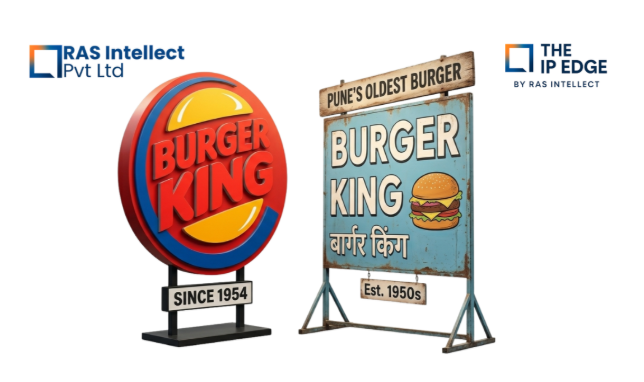
Since 1992, a small restaurant in Pune has operated under the name “Burger King.” It has never had more than two outlets. Its opponent in an ongoing trademark dispute is Burger King, the American fast-food chain with more than 13,000 restaurants worldwide. As of mid-2026, the Pune eatery is still using its name, still fighting the case, and has, at two separate levels of the Indian court system, come out ahead.
The dispute is a genuinely useful illustration of a principle that sits at the heart of trademark law in India and many other jurisdictions: registering a trademark first does not automatically defeat someone who was honestly using a similar name in the same market long before you arrived.
How the dispute started
Burger King Corporation registered “BURGER KING” as a trademark in India in 1979, but did not open its first Indian restaurant until 2014, initially in New Delhi. The Pune eatery, owned by Anahita and Shapoor Irani, had been operating since 1989 and began using the name “Burger King” specifically in 1992, more than two decades before the American chain’s first Indian outlet opened.
In 2008, aware of the Pune eatery, Burger King Corporation issued a legal caveat, and by 2011 had filed suit seeking a permanent injunction against the Iranis, along with damages. The Iranis opposed the claim, arguing that the American company had no operating restaurants in India at the time and could not establish common law trademark rights here based on foreign use alone.
What the trial court found
The District Court, Pune ruled on July 16, 2024, dismissing Burger King Corporation’s suit entirely. The trial judge found that the Pune eatery had been operating under the name well before the American company entered the Indian market, and held it qualified as a prior and honest user of the mark. The court also dismissed a separate counterclaim from the Iranis seeking roughly ₹20 lakh in damages for alleged harassment, finding insufficient evidence to support it, meaning neither side was awarded money at this stage.
The trial court’s reasoning rested on Section 34 of India’s Trade Marks Act, 1999, a provision that specifically protects someone who has continuously used an identical or similar mark from a date earlier than either the registered proprietor’s registration date or their actual first use of the mark in India, whichever is earlier. It’s a rule designed to prevent a later, larger entrant from displacing a smaller business that built genuine goodwill under a name first, simply because the bigger company happened to file paperwork earlier.
The appeal, and the back-and-forth since
Burger King Corporation appealed to the Bombay High Court. On August 26, 2024, a division bench of Justices A.S. Chandurkar and Rajesh Patil granted the American company interim relief, staying the trial court’s decision and reinstating an injunction against the Pune eatery pending the appeal. The bench indicated it intended to review the full evidentiary record itself as what it called the last “fact-finding” court in the matter, and directed both sides to preserve ten years of business records.
The Iranis then approached the Supreme Court. On March 7, 2025, a bench of Justices B.V. Nagarathna and Satish Chandra Sharma stayed the Bombay High Court’s restraining order, allowing the Pune eatery to continue operating under its name while the underlying appeal proceeds. The Supreme Court’s reasoning weighed the comparative harm to each side: the Pune outlet operated only two locations, against a global chain with a worldwide footprint, and the bench found that barring the smaller business from its own long-used name for the duration of a lengthy appeal would cause disproportionate harm relative to any interim harm the multinational company might suffer by waiting.
As of this writing, the Bombay High Court’s appeal remains pending on the merits, meaning no court has yet issued a final, non-interim ruling on who is actually entitled to use “Burger King” in Pune going forward. Every ruling so far, in both directions, has been about interim relief while the underlying case continues.
Why this case is worth following
Burger King Corporation’s trademark position in India isn’t weak in general; a Delhi High Court ruling in a separate 2023 case formally declared “Burger King” a well-known trademark in India, and restrained an unrelated business called “Burger Emperor” from using a similar mark. That makes the Pune case more interesting, not less: it shows that even a company holding a formally recognised well-known mark can still lose to a specific, narrower defence, prior and honest use in one particular local market, that has nothing to do with how famous the brand is nationally or globally.
For anyone building a brand, the practical lesson sitting underneath this dispute is straightforward. A trademark registration establishes a strong general right, but it isn’t absolute everywhere it’s asserted. A smaller, earlier, genuinely honest local user of a similar name can still hold a valid defence against a much larger, more famous claimant, and Indian courts have shown, across three different levels of this case so far, real willingness to protect that smaller user’s position while the fight over the merits continues.
Sources consulted for this piece: LiveLaw , Business Standard , Business Today , Lexology (DSK Legal and other contributors), RegisterKaro , and the European Commission’s IP Helpdesk (on the separate 2023 Delhi High Court “well-known mark” ruling). This piece was independently researched and written; no text has been reproduced from any source. As the underlying appeal remains pending before the Bombay High Court, the outcome described here reflects the case’s status as of this writing and may change.