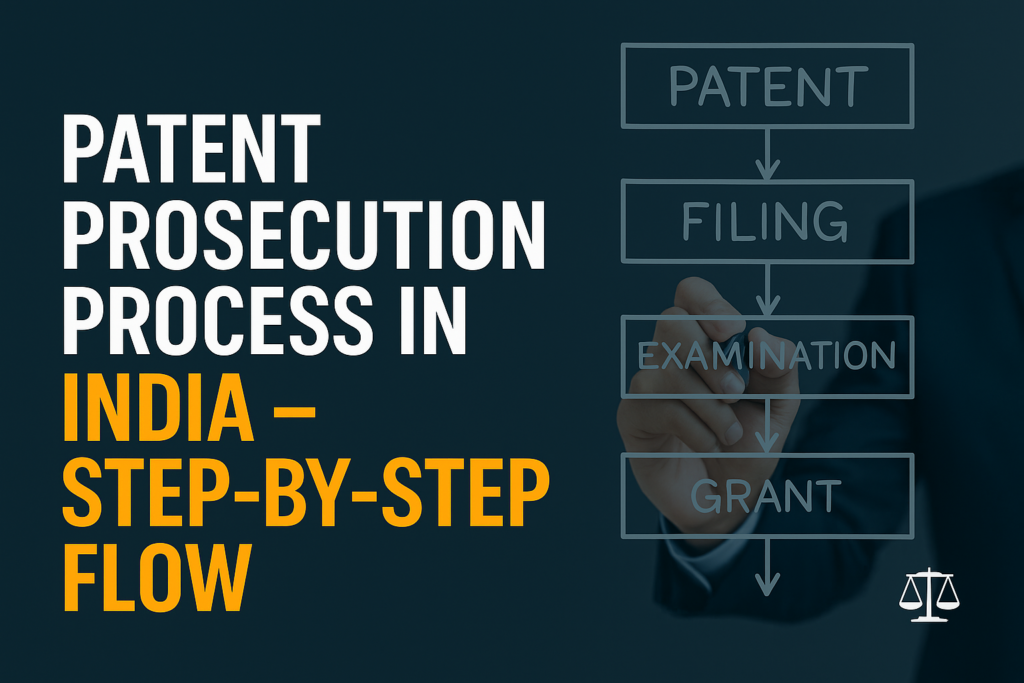
Patent prosecution is a topic that comes again and again in the Patent Agent Exam. This blog will help you understand the step-by-step flow of patent prosecution in India — from filing the application to getting a grant. We have explained everything in simple words, with clear steps, timelines, and examples for your patent agent exam Training.
Let’s Start with a Simple Situation
Imagine you created something new — like a special machine or a mobile app idea. You want to protect it so that no one can copy it.
You decide to file a patent.
But then you hear new words: “examination,” “FER,” “hearing,” “prosecution” — and everything becomes confusing.
That’s where this blog comes in.
Just like we follow steps to bake a cake or book a train ticket, there is a step-by-step process for getting a patent in India. This is called patent prosecution.
Why You Must Know This Process for the Exam
If you are preparing for the Patent Agent Exam, especially Paper I (Patent Act and Rules) and Paper II (Drafting and Interpretation), you must know:
- What happens after you file a patent
- What each stage means
- What deadlines apply at each step
- How to handle objections or replies
These questions are commonly asked in both the written exam and interviews.
What Will You Learn from This Blog
We will cover the full journey of a patent application in India:
- From filing the application
- To examination and response
- And finally, to grant or rejection
All steps are explained in simple English, with no heavy legal words.
Bookmark this guide. It could be helpful for you in future.
Step-by-Step Flow of Patent Prosecution in India
Step 1: Filing a Patent Application
You start by submitting a patent application to the Indian Patent Office. This can be a provisional or complete specification.
- Provisional application: Used if the invention is not fully ready. You get a priority date.
- Complete specification: Full details of the invention. Must be filed within 12 months of provisional application.
Key Forms:
- Form 1: Application for Grant of Patent
- Form 2: Specification (Provisional or Complete)
- Form 3: Statement and Undertaking
- Form 5: Declaration as to Inventorship
- Form 26: Authorisation of a Patent Agent/Or any Person in a Matter or Proceeding Under the Act
Step 2: Publication of Patent Application
After you file the complete application, it gets automatically published in the patent journal after 18 months.
You can also request for early publication using Form 9. If allowed, the application is published within 1 month.
Why publication is important:
- After publication, you can get damages from infringers (if your patent is later granted).
- Your invention becomes public knowledge.
Step 3: Request for Examination (RFE)
Just filing the application is not enough. You must also file a Request for Examination (Form 18).
This request must be filed within 31 months from the priority date (usually from the first filing date).
If you don’t file Form 18 on time, the application will be treated as withdrawn.
Step 4: Examination by Patent Office
Once RFE is filed, the patent office examines the application. An examiner checks if:
- The invention is new
- It involves an inventive step
- It is capable of industrial use
- It does not fall under non-patentable subject matter (Section 3 and 4)
The examiner then prepares a report, which becomes the First Examination Report (FER).
Step 5: Response to First Examination Report (FER)
The FER will contain objections, such as:
- Prior art (your invention already exists)
- Lack of clarity in claims
- Missing details
You have 6 months from the FER date to submit your reply.
You can:
- Modify your claims
- Submit explanations
- Meet with the Controller or attend a hearing
If the Controller is satisfied, the patent can move forward.
Step 6: Hearing (if required)
If the Controller still has doubts after your reply, you may be called for a hearing.
This is your chance to:
- Explain your invention in person
- Show how you’ve resolved the objections
- Answer technical/legal questions
After the hearing, the Controller will decide to grant or reject the patent.
Step 7: Grant of Patent
If everything is in order and objections are cleared, the Controller grants the patent.
- You get a Certificate of Grant
- Your name is published in the Patent Journal
- The patent lasts for 20 years from the filing date (if you pay annual renewal fees)
Congratulations — you are now a patentee!
Step 8: Post-Grant Compliance and Renewal
Even after getting a patent, there are responsibilities:
- File Form 27: Statement of working of patent — once every year
- Pay renewal fees every year, starting from the third year to keep the patent alive
- If you do not work the patent in India, it may become a reason for compulsory licence
Summary Table of Key Steps and Timelines
| Step | Description | Timeline / Forms |
| 1. Filing | Provisional or Complete Application | Form 1, 2, 3, 5, 26 |
| 2. Publication | Automatic or Early | 18 months / Form 9 |
| 3. RFE | Request for Examination | Within 48 months / Form 18 |
| 4. FER | First Examination Report | Issued after RFE |
| 5. Reply | Respond to objections | Within 6 months |
| 6. Hearing | Personal appearance (if needed) | Date given by Controller |
| 7. Grant | Patent is approved | Certificate + Journal Entry |
| 8. Renewal | Annual fee + Form 27 | Every year |
Common Questions and Confusions – Cleared
- Is patent prosecution same as litigation?
No. Prosecution means communication with the patent office to get a patent. Litigation means going to court. - What happens if I miss the RFE deadline?
Your application is considered withdrawn, and you lose the chance to get a patent. - Can a rejected patent be revived?
In some cases, yes — through review petitions or appeals to the Intellectual Property Appellate Board (IPAB) or court.
Useful Tip Before We Move On
Take a moment to bookmark this blog. Later, when you revise for Paper I or Paper II, this step-by-step breakdown will be easy to recall.
Pro Tips for Patent Agent Exam Training
- Memorise key forms and deadlines — they are often asked in MCQs.
- Practice writing responses to FER using sample objections.
- Read real FERs and hearing notices from the IP India website.
- Watch online videos where experts explain prosecution in action.
- Use past-year questions and mock exams to test your understanding.
Conclusion
Patent prosecution may sound complex at first, but once you know the flow, it becomes easy.
Just like solving a puzzle — once you get the outer frame, the rest fits in place.
You don’t need to remember heavy laws. You need to understand the sequence, know the purpose of each step, and be ready to explain it simply — that’s what the exam wants from you.
Keep learning one concept at a time. Stay consistent, and you’ll soon be confident in your preparation.