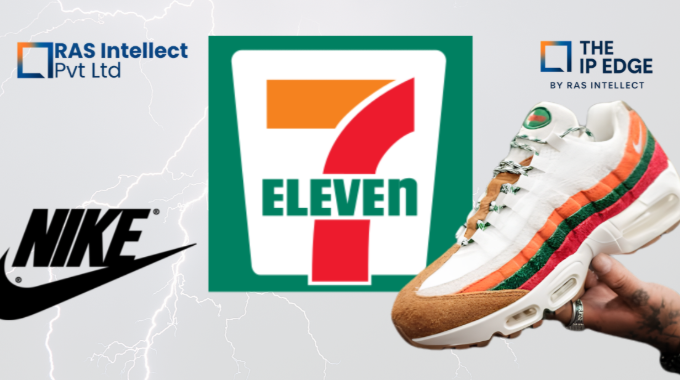
In early July 2026, Nike was preparing to release a new colorway of its Air Max 95, part of a 30th-anniversary lineup for the shoe, called the “Big Bubble Sport Green and Safety Orange.” The release date was set for July 11. On July 1, 7-Eleven filed a federal trademark lawsuit against Nike in the Northern District of Texas, seeking to stop the shoe from launching at all. Within days, the sneaker disappeared from Nike’s SNKRS app, and resale prices on the secondary market reportedly more than doubled.
The case is a genuinely useful, still-unresolved illustration of a few things that come up constantly in trademark law but rarely all at once in one dispute: whether a color combination alone can function as a trademark, what counts as evidence of bad faith, and how a lawsuit meant to stop consumer confusion can end up increasing demand for the very product it’s trying to block.
What 7-Eleven actually owns
7-Eleven’s claim rests on what it calls its “Tri-Color Mark,” the specific orange, green, and red combination that has appeared on its storefronts, signage, and branded merchandise since at least 1987. The company holds multiple federal trademark registrations covering this color combination, including US Trademark Registration No. 3,679,337. That matters because color marks occupy a slightly unusual place in trademark law. Colors were not always considered eligible for trademark protection at all, on the reasoning that a single company shouldn’t be able to monopolize a basic color that competitors might need. The US Supreme Court settled the question in Qualitex Co. v. Jacobson Products Co Inc . in 1995, holding that a color can serve as a valid trademark once it has acquired distinctiveness, meaning consumers have come to associate that specific color, or color combination, with a single commercial source, and provided the color isn’t functional to the product itself.
7-Eleven’s suit alleges seven counts, including federal trademark infringement, trademark dilution, and unfair competition under the Lanham Act, the primary US federal trademark statute. It’s seeking an injunction stopping the shoe’s promotion and sale, destruction of existing inventory, disgorgement of Nike’s profits from the shoe, damages, and attorney’s fees.
Why 7-Eleven says this wasn’t a coincidence
Trademark infringement claims generally turn on likelihood of confusion, and evidence of intentional copying tends to strengthen a plaintiff’s case considerably. 7-Eleven’s complaint leans heavily on a cluster of details it argues point to deliberate association rather than accident. The release date, July 11, lands on what the company calls “7-Eleven
Day,” its own branded promotional holiday built around the date format. The shoe’s colorway uses orange, green, and red in an arrangement 7-Eleven says mirrors its own branding. According to the complaint, the sneaker’s insole even featured a graphic resembling convenience store shelving. And, perhaps most concretely, 7-Eleven points to online product listings that referred to the shoe outright as the “7-Eleven shoe,” which the company argues is direct evidence that consumers were already forming the exact association the lawsuit is trying to prevent.
The dispute also has real history behind it. 7-Eleven and Nike had worked together before, on an officially licensed Nike SB Dunk Low colorway planned around the Tokyo 2020 Olympics, which was ultimately scrapped after the Games were postponed. 7-Eleven’s complaint uses that scrapped collaboration to argue that consumers had genuine reason to believe a real partnership might exist here too, since the two companies do have an actual history of working together on footwear, unlike a purely hypothetical association a plaintiff might otherwise have to speculate about.
The irony sitting inside the lawsuit
Nike has not publicly responded to the complaint. But the practical effects arrived almost immediately regardless of any court ruling: the shoe came off Nike’s official sales app, and secondary market prices for it reportedly climbed sharply once news of the lawsuit spread. That’s a genuinely interesting wrinkle for a case fundamentally about preventing consumer confusion, the legal action itself generated exactly the kind of publicity and scarcity that tends to drive demand in sneaker culture, independent of whatever a court eventually decides about the merits.
Why this case is worth following
This isn’t 7-Eleven’s first time defending this specific color combination. In 2024, the company settled a separate infringement suit against a law firm called Seven Eleven Law Group, over its use of a similar green-and-white color scheme and name on its website and business materials. Together, the two cases show a company treating its color identity as an asset worth defending consistently, not just against obvious counterfeits, but against uses in completely unrelated industries, sneakers, and law firms, where dilution theory, rather than direct competition, does the legal work of connecting the dots.
For anyone building a brand around a distinctive color scheme, this case is worth watching for what it will eventually say about how far that protection extends against a use that never claims to be an official collaboration at all. As of this writing, the case remains pending, and no ruling on the merits has been issued.
Sources consulted for this piece: WWD, Footwear News , C-Store Dive , SGB Media , Sole Retriever , and SSW IP Law’s analysis of the complaint, along with background on Qualitex Co. v. Jacobson Products Co., 514 U.S. 159 (1995). This piece was independently researched and written; no text has been reproduced from any source beyond the short attributed quotes above.