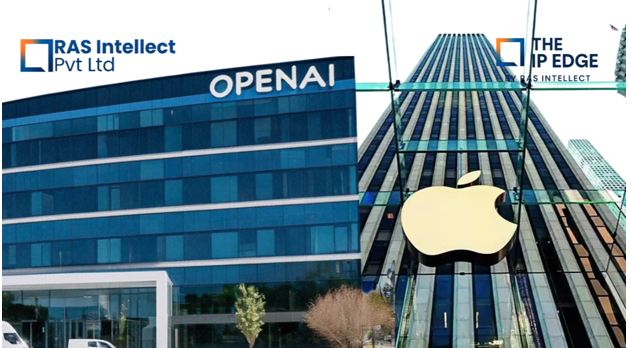
Apple is suing OpenAI over trade secrets. The hearing is days away, and the real fight is over one question: what exactly is the secret?

On July 10, 2026, Apple filed a lawsuit in the U.S. District Court, Northern District of California against OpenAI, its hardware subsidiary io Products, and two former Apple employees, alleging misappropriation of trade secrets and breach of contract. According to the complaint, more than 400 former Apple employees now work at OpenAI, and Apple says the company’s push into consumer hardware rests in part on confidential Apple information. OpenAI denies the allegations. A hearing on Apple’s request for a preliminary injunction, and on OpenAI’s motion to dismiss, is scheduled for October 1, 2026.

Nothing here has been proven, and the court has not granted any injunction. That is worth stating plainly, because the case is a useful window into something IP lawyers and founders often underestimate: trade secrets are the one form of intellectual property you never file, and so the entire dispute tends to turn on conduct and proof rather than on a registration certificate.

What Apple alleges, and what OpenAI says

Apple’s complaint names The OpenAI Foundation, Open AI Group PBC, io Products (the device startup OpenAI acquired last year in a deal reported at $6.5 billion), a former Apple engineer, and Tang Tan, a former Apple design executive who is now OpenAI’s chief hardware officer. As reported, Apple alleges that OpenAI encouraged Apple employees to bring designs and prototypes to job interviews, coached departing employees on avoiding Apple’s exit security procedures, and advised them not to sign documents at exit interviews. It also alleges that one former engineer exploited a security bug to download confidential engineering files, and that io used Apple’s metal-finishing know-how. Apple’s filing says OpenAI’s hardware business “rests on the shakiest of foundations” because of the alleged reliance on misappropriated information.

OpenAI says it has no interest in other companies’ trade secrets, has published its own account disputing parts of Apple’s version of events, and has moved to dismiss the case. Its lawyers call the suit a “baseless and pretextual lawsuit” and argue that Apple has never properly identified what information actually qualifies as a protectable trade secret. In late September, OpenAI also accused Apple of improperly adding new evidence in its reply papers.

The legal core: define the secret before you can protect it

Trade secret law protects information that has commercial value because it is not generally known, and that its owner has taken reasonable steps to keep secret. There is no registry, no fixed term, and no examination. Protection lasts only as long as the secrecy does, and it offers no defence against someone who independently develops the same thing. In the United States, the Defend Trade Secrets Act of 2016 gives owners a federal civil claim, and it is the statute OpenAI’s motion focuses on.

OpenAI’s argument is a familiar one in these cases. To state a claim, it says, a plaintiff has to connect three things for the same information and the same defendant: what the specific secret is, why it qualifies for protection, and how the defendant improperly acquired, disclosed, or used it. Broad descriptions of confidential engineering knowledge, on this view, are not enough. Courts care about this because an injunction has to be specific enough to be obeyed, and a defendant cannot be ordered to stop using something nobody has clearly defined. Apple, for its part, says its evidence is concrete and that the harm grows with every day the alleged information is embedded into a competitor’s product.

The California wrinkle: 400 departures are not enough

There is a second reason this case will be argued the way it is. California voids most employee non-compete agreements under its Business and Professions Code, and in Whyte v. Schlage Lock Co. in 2002, a California appeals court rejected the “inevitable disclosure” doctrine, the idea that a former employee will inevitably use a previous employer’s secrets in a similar new job. The court reasoned that the doctrine would operate as an after-the-fact non-compete. In practical terms, a California plaintiff cannot win simply by pointing to how many employees changed jobs. It has to show actual or threatened misappropriation, which is why Apple’s complaint concentrates on specific alleged conduct such as file downloads and interview practices.

The contrast with other jurisdictions is instructive, and slightly ironic. In 2008, a federal court in New York granted IBM a preliminary injunction in a dispute over an executive, Mark Papermaster, who was moving from IBM to Apple, in a case involving both a non-compete and trade secrets. Apple was then on the receiving end of the argument it now cannot rely on in California.

Why this matters for India

India has no dedicated trade secrets statute. Protection comes from contract law, the equitable doctrine of breach of confidence, and related provisions in other laws. Section 27 of the Indian Contract Act, which treats agreements in restraint of trade as void, limits how far employers can enforce post-employment non-competes, a policy similar in spirit to California’s. In March 2024, the Law Commission of India’s 289th Report recommended a standalone trade secrets law and attached a draft bill, but according to recent commentary that recommendation has not yet been turned into legislation. Commentators also note that Indian courts expect a claimant to clearly identify the secret at issue, which is the same pressure point OpenAI is pressing in California.

For Indian startups, research institutions, and employers, the practical lessons are the ones this dispute keeps circling back to. Know what your secrets actually are and write them down. Restrict access on a need-to-know basis. Use enforceable confidentiality agreements rather than relying on non-competes. And treat onboarding and exit procedures as part of your IP protection, because in a trade secret case, how you protected the information is often the evidence.

Sources consulted for this piece: Reuters (via NBC News), TechCrunch , Bloomberg (via Claims Journal), 9to5Mac , MacRumors.com , JURIST , AppleMagazine , and OpenAI’s public statement on the case; the decision in Whyte v. Schlage Lock Co. (Cal. Ct. App. 2002) via Justia, CourtListener, and FindLaw; Wikipedia on IBM v. Papermaster; and, for the India section, Lexology, Cyril Amarchand Mangaldas’s blog, AZB & Partners, the Law Commission of India’s Report No. 289, and commentary from IRCCL and Record of Law. This piece was independently researched and written; no text has been reproduced from any source beyond the two short attributed quotes above. The allegations described are unproven, and the situation may change after the October 1 hearing.
Scroll to Top
Sachin Kumar

Sachin Kumar

Publication Trainee

Sachin Kumar is a Publication Trainee at RAS Intellect Solution Pvt. Ltd. Mohali. His core work is in the field of scientific publishing, research communication, and data-driven analytics. He is involved in the publication process of journal articles, conference papers and technical reports, maintaining high standards of quality and academic compliance. With a strong foundation in Business Analytics and Finance, his expertise lies at the intersection of statistics, economics, and psychology. He possesses advanced knowledge of statistical modeling, data visualization, and predictive analytics, with proficiency in Python, R, SQL, and Machine Learning. His deep understanding of statistics, combined with interests in economics and psychology, provides a unique interdisciplinary perspective on consumer behavior, market dynamics, and human decision-making.  He holds an MBA with a major in Business Analytics and a minor in Marketing from Indsearch Institute of Management Studies & Research, Pune, and a Bachelor’s in Commerce (Honours) with specialization in Finance & Accounting from Munger University, Bihar

Aman Kumar Puri

Senior Associate – Business Development

As a Senior Business Development Associate at RAS Intellect Solutions Pvt. Ltd., He is responsible for developing international business opportunities and building strategic relationships with patent attorneys, intellectual property law firms, corporate IP teams, technology companies. His role involves understanding client requirements, identifying opportunities where specialized IP support can add value, and connecting clients with our technical and intellectual property experts to deliver efficient, high-quality solutions.

His primary focus is on creating sustainable international partnerships that enable IP firms and corporate legal teams to access specialized technical expertise, scalable execution capacity, and cost-effective IP support when they need additional bandwidth or specialized capabilities. Through a combination of strategic prospecting, relationship management, consultative selling, and collaboration with technical teams, He works to create opportunities that deliver measurable value to both clients and RAS Intellect Solutions.

Karandeep Singh

IP Manager

Experienced Intellectual Property & Technology Consultant with 9+ years of experience and a demonstrated history of working in IPR Industry. Strong operations professional with a Bachelor of Engineering focused in Electronics & Communication (ECE). Well versed in handling a team of research analysts and work with them to achieve common goals.   Proficient in projects including but not limited to: · Patentability Searches, Invalidation/ Opposition/ Prior Art Searches, FTO, Landscape/White Space analysis, Portfolio Analysis, Design Searches. · State-of-the-art searches, Patent Watch, Infringement analysis · Patent Valuation/ Monetization – Qualitative/ Quantitative Methods, Net Present Value (NPV), Income Based, Market Based Approach. Handled various projects on technologies: · Quantum Computing, Random Number Generators (RNGs), Autonomous vehicle (AV) technology, EMI filters, AI, ML, AR/VR etc. · Limited projects on – 3GPP, ETSI, DVB standards. Worked on presales presentations, discussions, and client calls. Preparation of discussion initiation documents for new client engagements/ meetings and pitching. Database Expertise : Questel Orbit, Patseer, Derwent Innovation, AI based (IPRally, Ambercite, PQAI) etc.

Kriti Pandey

Senior Executive, HR & Accounts

Kriti Pandey is a Senior Executive in HR and Accounts at RAS Intellect, managing end-to-end HR operations alongside financial and compliance processes. With over three years of experience, she oversees employee lifecycle management, payroll, HRIS administration, and organizational compliance. She has worked with global teams, including supporting a UK-based workforce, and brings strong expertise in compensation, performance management, and employee engagement. An MBA in Human Resources, Kriti focuses on building structured, scalable systems that support efficient business operations. 

Kartik Chauhan

Trademark & Copyright Analyst

Kartik Chauhan is a Trademark and Copyright Analyst at RAS Intellect, working across trademark searches, application support, and intellectual property documentation. He assists in preparing filings, addressing objections, and supporting clients in securing and managing their IP rights. In addition to trademarks, he contributes to patent drafting and corporate compliance processes. With a background in computer science engineering and interests in technology law and research, he brings a multidisciplinary perspective to his work. His analytical and technical skills support both IP protection and compliance-driven initiatives.

Isha Kansal

Senior Patent Analyst

Isha Kansal is a Senior Patent Analyst at RAS Intellect, specializing in patent drafting, filing, and post-filing prosecution support. Her work involves preparing patent specifications, managing paralegal documentation, and handling renewal, restoration, and NBA-related filings. With a strong academic foundation in chemistry and hands-on exposure to organic chemistry and cosmetic science, she brings domain-specific insight to her IP work. Her expertise spans chemical, pharmaceutical, and allied science innovations, where she applies a structured and detail-oriented approach. Isha plays a key role in ensuring accuracy and consistency across critical stages of the patent lifecycle.

Dr. Neha Dhiman

Publication Lead

Dr. Neha Dhiman leads the Publications vertical at RAS Intellect, overseeing end-to-end research publication processes for journals, conferences, and technical reports. With over 12 years of experience in teaching and research, she specializes in scientific writing, academic compliance, and high-quality research communication. Her expertise spans material science, wastewater treatment, and environmental remediation using nanotechnology and agricultural waste. A Ph.D. holder and DST INSPIRE Fellow, she has authored multiple research papers and book chapters and actively contributes as a reviewer and editorial board member. Her work ensures rigorous, publication-ready outputs aligned with global academic standards. 

Shreya Singla

Director HR & Marketing  

Shreya Singla leads Human Resources and Marketing at RAS Intellect, focusing on talent development, brand building, and strategic growth initiatives. A Biology graduate from the University of British Columbia, she brings a research-driven and analytical approach to organizational development and market positioning. 

At RAS Intellect, she is actively involved in hiring, team structuring, and strengthening internal processes, while also driving digital marketing, content strategy, and outreach initiatives. Her work has contributed to significant growth in the firm’s online presence, including increased website traffic, high-engagement campaigns, and expanding visibility across domestic and international audiences. 

She plays a key role in scaling flagship initiatives such as RASPREP, managing student engagement, program execution, and outreach. With a blend of analytical thinking and creative execution, she focuses on building scalable systems, strengthening brand identity, and aligning talent with long-term organizational goals. 

Atul Singla

Co-founder & Director 

Atul Singla is a Co-founder of RAS Intellect and a seasoned industry leader with extensive experience in manufacturing, operations, and business development. As Managing Director of Cable House, Chandigarh, he has led the growth of a well-established enterprise in electrical cables, wiring systems, and allied infrastructure solutions. His expertise spans strategic planning, supply chain management, vendor coordination, and operational scalability across industrial environments. 


With a strong focus on quality compliance and execution efficiency, he brings a practical, business-oriented perspective to organizational growth. At RAS Intellect, he contributes to strategic direction, operational structuring, and long-term business expansion. His approach is rooted in building sustainable systems, ensuring reliability, and driving consistent value across operations. 

Dr. Ruchi Singla 

Director & CEO 

Dr. Ruchi Singla is the Director and CEO of RAS Intellect, bringing over two decades of experience across research, innovation, and academic leadership. She serves as a Scientific Advisor to IP India and has previously held leadership roles including Director at ACIC RISE (NITI Aayog) and Associate Director at Chandigarh University. An accomplished innovation leader, she has guided over 2,300 patent filings and led the establishment of multiple Centres of Excellence, with a focus on emerging domains such as AI, drones, and cybersecurity. 


Recognised among the top mentors in India, she is a Regional Mentor of Change under the Atal Innovation Mission and has actively supported startups, particularly in the agritech space. Dr. Singla holds a Ph.D. in Wireless Communication and is a certified Canadian Patent Administrator from the Intellectual Property Institute of Canada. With extensive contributions to research, patents, and innovation ecosystems, her work is centered on building scalable, impact-driven intellectual property and research frameworks. 

Vanshika Sharma

Business Development Analyst

Vanshika Sharma is a Business Development Analyst at RAS Intellect, with experience in lead generation, client outreach, and academic program management. She is responsible for identifying prospective clients, managing CRM systems, and coordinating outreach for IP services, publication support, and the RASPREP program. She also plays a key role in managing RASPREP operations, including student coordination, communication, and lead tracking. In addition, she supports patent-related work through prior art searches. With a background in computer science and ongoing MBA in Marketing and AI in Business, she brings a structured and data-driven approach to business development. 

Anu Bala coloured

Anu Bala

Intellectual Property Team Lead

Anu Bala is a seasoned intellectual property professional with over 16 years of experience across patents, trademarks, copyrights, and technology transfer. As IP Lead at RAS Intellect, she leads patent drafting and filing strategies, prior art searches, and end-to-end IP prosecution, while also advising on commercialization-focused IP pathways. A Registered Indian Patent Agent and empaneled facilitator under the Startup India SIPP Scheme, she brings strong regulatory and strategic expertise to complex IP matters. She has previously contributed to national-level policy initiatives at ICMR, including the ICMR–DHR Policy on Biomedical Innovation and Entrepreneurship, and has been actively involved in capacity-building and translational research programs. Recognized among the DST Women Scientists under the WISE–KIRAN programme, Anu’s work is centered on transforming research into well-protected, market-ready intellectual property.

Suryavanshi Katoch

Patent Drafter

Suryavanshi Katoch is a Patent Drafter at RAS Intellect, specializing in patent drafting, techno-legal analysis, and IP documentation. He has experience working on Indian, U.S., and European patent applications, including claim drafting, FER responses, and invention disclosure development. His technical background in electronics and communication engineering enables him to work across domains such as electronics, mechanical systems, and robotics. He also supports design filings through 3D design preparation and documentation. With a strong focus on clarity and structure, he contributes to developing precise, protection-oriented patent specifications.