Theme: Trademark law (pharma brands and export-only use)
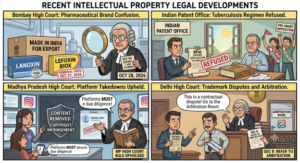
Bombay High Court orders removal of “LEFOXIN BIOX” over similarity to Glaxo’s “LANOXIN”
On October 28, 2026, Justice Somasekhar Sundaresan of the Bombay High Court directed the Registrar of Trade Marks to remove Shreya Life Sciences’ “LEFOXIN BIOX” mark from the register with effect from December 31, 2026. Glaxo Group had sought removal under Section 57 of the Trade Marks Act, 1999, saying its “LANOXIN” mark has been in continuous use since 1956.
Shreya argued that it makes the product in India only for export and sells nothing domestically. The Court held that manufacturing and branding goods in India for export counts as use in India under Section 56. It also found that the marks could cause confusion despite differences in the medicines’ ingredients and medical uses, a concern that carries extra weight for pharmaceuticals. Shreya has until the removal date to run a communications campaign announcing its new name from January 1, 2027.
Theme: Patent law (pre-grant opposition and public health)
Indian Patent Office refuses patent for TB Alliance’s BPaL tuberculosis regimen
The Indian Patent Office has rejected a patent application by the Global Alliance for TB Drug Development (TB Alliance) for BPaL, a six-month, all-oral regimen of bedaquiline, pretomanid, and linezolid for drug-resistant tuberculosis. The decision was reported on October 28 and 29, 2026.
Several civil society organisations had filed pre-grant oppositions against the application in July 2020. The Patent Office cited lack of novelty, absence of an inventive step, non-patentability, and insufficient disclosure. Reports say the opponents argued that the combination, and its use in a shorter regimen, had been disclosed in earlier research and clinical trials dating back to 2015. The decision means this application has not resulted in a patent in India, and health groups have urged TB Alliance to withdraw related claims in other countries. The reports reviewed do not say whether TB Alliance will challenge the decision.
Theme: Copyright law (platform takedowns)
Madhya Pradesh High Court upholds IT Rule allowing platforms to remove copyright-infringing posts
The Madhya Pradesh High Court has dismissed a challenge to Rule 3(1)(b)(iv) of the IT (Intermediary Guidelines and Digital Media Ethics Code) Rules, 2021, which requires social media platforms to make reasonable efforts to keep infringing content off their services. The Division Bench of Chief Justice Alpesh Y. Kogje and Justice Vivek Rusia heard Anmol Jain v. Union of India on September 17 and reserved its order, which became available in October.
The petitioner, who runs an Instagram account with about 39,000 followers, had his posts removed after copyright complaints and his account suspended. He argued that a private platform should not decide copyright violations without adjudication, and that he had no hearing. The Court held that Instagram is an intermediary that must follow the Rules’ due diligence requirements, which include grievance routes for users. Reports say it did not decide whether Instagram wrongly removed his posts.
Theme: Trademark law (licence disputes and arbitration)
Delhi High Court sends Utracon trademark dispute to arbitration
On October 28, 2026, Justice Purushaindra Kumar Kaurav of the Delhi High Court allowed an application under Section 8 of the Arbitration and Conciliation Act, 1996, and referred a trademark suit to arbitration. In Utracon Corporation Pte Ltd v. Ucon PT Structural System Pvt Ltd, the Singapore-based company sued its former Indian subsidiary and others for infringement and passing off over their continued use of the “UTRACON” mark after a licence expired.
The Court held that a party cannot avoid an arbitration agreement merely by adding a relief that may not itself be arbitrable. It found the dispute to be contractual, concerning rights between the parties, and not necessarily non-arbitrable. It also noted that the claims against the affiliates and directors arose from the same contract.