RASPREP first batch is complete Buy the RASPREP books online including questionnaires and past year papers For more information contact us

The 7 Step Patent Journey: A Roadmap for Aspiring Inventors

August has arrived, and with it, a new focus for our IP Edge newsletter. Following our look at the inspiring “Women in Innovation” last month, we now turn our attention to a theme that is essential for every aspiring inventor and entrepreneur: Patent Process Simplified.  

In a world driven by a national vision for Viksit Bharat, where innovation is the engine of growth, understanding how to protect your intellectual property has never been more critical. The Indian government has made significant strides in streamlining the patent system, with initiatives like fee concessions for startups and women inventors, and faster examination processes. At RAS Intellect, we are committed to making this journey accessible and understandable for innovators in Punjab and beyond. We believe that a simplified patent process is a powerful tool that empowers individuals to turn their ideas into assets, driving economic progress and technological self-reliance for India. This month, we will break down the process into clear, actionable steps to help you navigate the path from a great idea to a granted patent. 


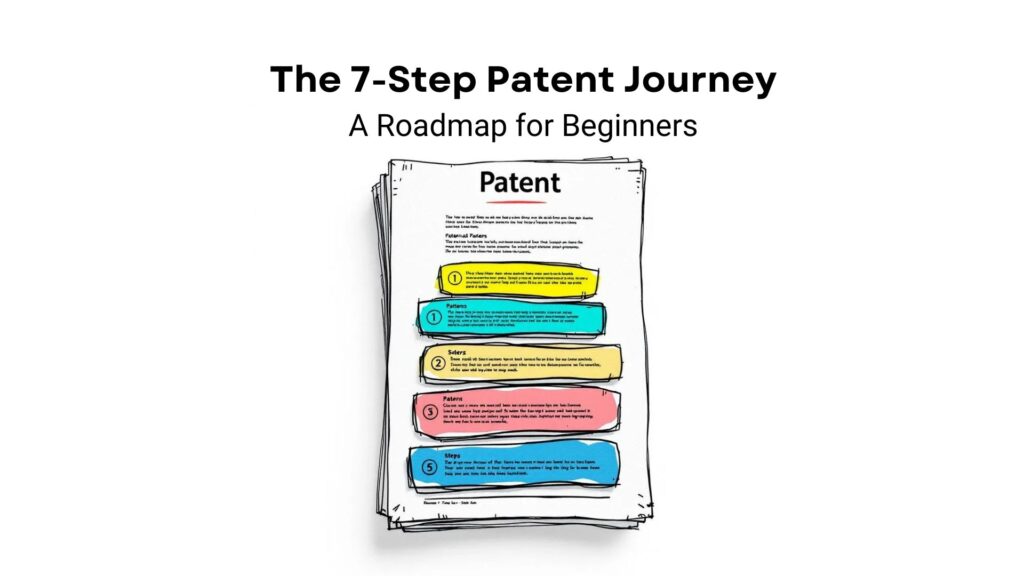
The 7-Step Patent Journey: A Roadmap for Beginners 

So, you’ve got a brilliant idea brewing, a game-changing invention that you think could be the next big thing? That’s fantastic! But where do you go from that lightbulb moment? The world of patents can seem daunting, filled with jargon and complex procedures. But don’t worry, it doesn’t have to be a mystery. Think of the patent process as a journey with distinct milestones. Here’s a simplified roadmap to guide you through the 7 key steps to potentially securing your intellectual property rights. 

And how does this relate to our national vision of a Viksit Bharat (Developed India)? Innovation is the bedrock of progress. By understanding and navigating the patent process effectively, Indian inventors, startups, and established organizations can protect their groundbreaking ideas, foster a culture of indigenous innovation, and drive economic growth. Patents not only grant exclusive rights but also incentivize further research and development, ultimately contributing to a technologically advanced and self-reliant India. 

At RAS Intellect, we believe in empowering innovation at all levels. Our newsletter, “IP Edge,” aims to demystify the intricacies of Intellectual Property, making it accessible to everyone. Understanding the “Patent Process Simplified,” this month’s theme, is crucial for individuals and organizations in Punjab, and across the nation who are contributing to India’s journey towards becoming a global innovation hub. 

Step 1: Conception & Meticulous Documentation  

Every great patent journey starts with a spark of an idea. The crucial first step is to clearly define and document your invention. This means more than just a mental note! 

  • Detailed Description: Write down everything you can about your invention. What problem does it solve? How does it work? What are its key features and components? Include diagrams, sketches, and even rough prototypes if possible. 
  • Date and Sign: Make sure to date and sign your records, and have them witnessed by someone you trust who understands the invention. These records can be crucial for establishing your “date of invention.” Think of it as creating the first entry in your invention’s official logbook. 

Step 2: Exploring the Neighborhood: The Prior Art Search  

Before you invest too much time and money, it’s wise to see if something similar already exists. This is where a prior art search comes in. 

  • What is it? It’s essentially a search through existing patents, publications, and other public disclosures to see if your invention is truly novel. 
  • Why do it? It can save you significant time and money by preventing you from pursuing a patent for something that’s already been invented. It can also give you insights into existing technologies and help you refine your own invention. While not strictly mandatory, it’s highly recommended. This proactive step aligns with the vision of Viksit Bharat by ensuring our innovative efforts are truly novel and impactful on a global scale. 

Step 3: Putting it on Paper: Drafting the Patent Application  

This is where your invention starts to take formal shape. You’ll need to prepare a detailed patent application, which is a technical document describing your invention in specific legal terms. 

  • Provisional vs. Non-Provisional: You have two main types of applications to choose from. A provisional patent application (PPA) establishes an early filing date and gives you 12 months to file a more formal non-provisional patent application (NPA). The NPA is the one that gets examined for patentability. For Indian innovators contributing to Viksit Bharat, understanding these options allows for strategic planning of their IP protection. 
  • Claims are Key: The “claims” section of your application defines the legal scope of your invention – what exactly you are seeking to protect. This part requires precision and is often where the expertise of a patent attorney can be invaluable. 

Step 4: Officially Introducing Your Invention: Filing the Application  

Once your application is drafted, it’s time to officially submit it to the relevant patent office (e.g., the Indian Patent Office). This step establishes your official filing date, which is crucial for determining priority if someone else independently invents something similar later. A robust and increasing number of patent filings from India will be a strong indicator of our progress towards Viksit Bharat. 

Step 5: Under the Microscope: Examination and Office Actions  

After filing, your non-provisional application will be assigned to a patent examiner who will review it for compliance with patent laws and regulations, including novelty and non-obviousness. This often leads to office actions, which are official letters from the examiner outlining any objections or issues with your application. RAS Intellect’s “IP Edge” aims to equip our readers with the knowledge to navigate this stage effectively. 

Step 6: Addressing the Concerns: Responding to Objections  

Receiving an office action isn’t the end of the road! It’s an opportunity to clarify aspects of your invention, amend your claims, or argue why the examiner’s objections are incorrect. Crafting a well-reasoned response to the office action is a critical part of the process. Perseverance and a thorough understanding of the patent process are vital for Indian inventors looking to secure their IP rights and contribute to Viksit Bharat. 

Step 7: The Finish Line: Grant of Patent  

If the examiner is satisfied that your invention meets all the patentability requirements, you will receive a notice of allowance. After paying the required fees, your patent will be granted! This gives you the exclusive right to exclude others from making, using, selling, or importing your invention for a specific period. This milestone not only benefits the individual inventor or organization but also strengthens India’s overall innovation ecosystem, a key element of Viksit Bharat. 

The Journey Continues… 

While getting a patent granted is a significant achievement, remember that maintaining your patent often involves periodic renewal fees. Understanding these 7 basic steps is the first stride towards protecting your innovative ideas. At RAS Intellect, we are committed to bringing you more insights on navigating the patent landscape. Stay tuned for our next article where we’ll delve deeper into the difference between provisional and non-provisional patent applications!  

Let’s work together to fuel India’s journey towards Viksit Bharat through the power of innovation and intellectual property. 
 

Scroll to Top

Kriti Pandey

Senior Executive, HR & Accounts

Kriti Pandey is a Senior Executive in HR and Accounts at RAS Intellect, managing end-to-end HR operations alongside financial and compliance processes. With over three years of experience, she oversees employee lifecycle management, payroll, HRIS administration, anorganizational compliance. She has worked with global teams, including supporting a UK-based workforce, and brings strong expertise in compensation, performance management, and employee engagement. An MBA in Human Resources, Kriti focuses on building structured, scalable systems that support efficient business operations. 

Kartik Chauhan

Trademark & Copyright Analyst

Kartik Chauhan is a Trademark and Copyright Analyst at RAS Intellect, working across trademark searches, application support, and intellectual property documentation. He assists in preparing filings, addressing objections, and supporting clients in securing and managing their IP rights. In addition to trademarks, he contributes to patent drafting and corporate compliance processes. With a background in computer science engineering and interests in technology law and research, he brings a multidisciplinary perspective to his work. His analytical and technical skills support both IP protection and compliance-driven initiatives.

Isha Kansal

Senior Patent Analyst

Isha Kansal is a Senior Patent Analyst at RAS Intellect, specializing in patent drafting, filing, and post-filing prosecution support. Her work involves preparing patent specifications, managing paralegal documentation, and handling renewal, restoration, and NBA-related filings. With a strong academic foundation in chemistry and hands-on exposure to organic chemistry and cosmetic science, she brings domain-specific insight to her IP work. Her expertise spans chemical, pharmaceutical, and allied science innovations, where she applies a structured and detail-oriented approach. Isha plays a key role in ensuring accuracy and consistency across critical stages of the patent lifecycle.

Dr. Neha Dhiman

Publication Lead

Dr. Neha Dhiman leads the Publications vertical at RAS Intellect, overseeing end-to-end research publication processes for journals, conferences, and technical reports. With over 12 years of experience in teaching and research, she specializes in scientific writing, academic compliance, and high-quality research communication. Her expertise spans material science, wastewater treatment, and environmental remediation using nanotechnology and agricultural waste. A Ph.D. holder and DST INSPIRE Fellow, she has authored multiple research papers and book chapters and actively contributes as a reviewer and editorial board member. Her work ensures rigorous, publication-ready outputs aligned with global academic standards. 

Shreya Singla

Director HR & Marketing  

Shreya Singla leads Human Resources and Marketing at RAS Intellect, focusing on talent development, brand building, and strategic growth initiatives. A Biology graduate from the University of British Columbia, she brings a research-driven and analytical approach to organizational development and market positioning. 

At RAS Intellect, she is actively involved in hiring, team structuring, and strengthening internal processes, while also driving digital marketing, content strategy, and outreach initiatives. Her work has contributed to significant growth in the firm’s online presence, including increased website traffic, high-engagement campaigns, and expanding visibility across domestic and international audiences. 

She plays a key role in scaling flagship initiatives such as RASPREP, managing student engagement, program execution, and outreach. With a blend of analytical thinking and creative execution, she focuses on building scalable systems, strengthening brand identity, and aligning talent with long-term organizational goals. 

Atul Singla

Co-founder & Director 

Atul Singla is a Co-founder of RAS Intellect and a seasoned industry leader with extensive experience in manufacturing, operations, and business development. As Managing Director of Cable House, Chandigarh, he has led the growth of a well-established enterprise in electrical cables, wiring systems, and allied infrastructure solutions. His expertise spans strategic planning, supply chain management, vendor coordination, and operational scalability across industrial environments. 


With a strong focus on quality compliance and execution efficiency, he brings a practical, business-oriented perspective to organizational growth. At RAS Intellect, he contributes to strategic direction, operational structuring, and long-term business expansion. His approach is rooted in building sustainable systems, ensuring reliability, and driving consistent value across operations. 

Dr. Ruchi Singla 

Director & CEO 

Dr. Ruchi Singla is the Director and CEO of RAS Intellect, bringing over two decades of experience across research, innovation, and academic leadership. She serves as a Scientific Advisor to IP India and has previously held leadership roles including Director at ACIC RISE (NITI Aayog) and Associate Director at Chandigarh University. An accomplished innovation leader, she has guided over 2,300 patent filings and led the establishment of multiple Centres of Excellence, with a focus on emerging domains such as AI, drones, and cybersecurity. 


Recognised among the top mentors in India, she is a Regional Mentor of Change under the Atal Innovation Mission and has actively supported startups, particularly in the agritech space. Dr. Singla holds a Ph.D. in Wireless Communication and is a certified Canadian Patent Administrator from the Intellectual Property Institute of Canada. With extensive contributions to research, patents, and innovation ecosystems, her work is centered on building scalable, impact-driven intellectual property and research frameworks. 

Vanshika Sharma

Business Development Analyst

Vanshika Sharma is a Business Development Analyst at RAS Intellect, with experience in lead generation, client outreach, and academic program management. She is responsible for identifying prospective clients, managing CRM systems, and coordinating outreach for IP services, publication support, and the RASPREP program. She also plays a key role in managing RASPREP operations, including student coordination, communication, and lead tracking. In addition, she supports patent-related work through prior art searches. With a background in computer science and ongoing MBA in Marketing and AI in Business, she brings a structured and data-driven approach to business development. 

Anu Bala coloured

Anu Bala

Intellectual Property Team Lead

Anu Bala is a seasoned intellectual property professional with over 16 years of experience across patents, trademarks, copyrights, and technology transfer. As IP Lead at RAS Intellect, she leads patent drafting and filing strategies, prior art searches, and end-to-end IP prosecution, while also advising on commercialization-focused IP pathways. A Registered Indian Patent Agent and empaneled facilitator under the Startup India SIPP Scheme, she brings strong regulatory and strategic expertise to complex IP matters. She has previously contributed to national-level policy initiatives at ICMR, including the ICMR–DHR Policy on Biomedical Innovation and Entrepreneurship, and has been actively involved in capacity-building and translational research programs. Recognized among the DST Women Scientists under the WISE–KIRAN programme, Anu’s work is centered on transforming research into well-protected, market-ready intellectual property.

Suryavanshi Katoch

Patent Drafter

Suryavanshi Katocis a Patent Drafter at RAS Intellect, specializing in patent drafting, techno-legal analysis, and IP documentation. He has experience working on Indian, U.S., and European patent applications, including claim drafting, FER responses, and invention disclosure development. His technical background in electronics and communication engineering enables him to work across domains such as electronics, mechanical systems, and robotics. He also supports design filings through 3D design preparation and documentation. With a strong focus on clarity and structure, he contributes to developing precise, protection-oriented patent specifications.