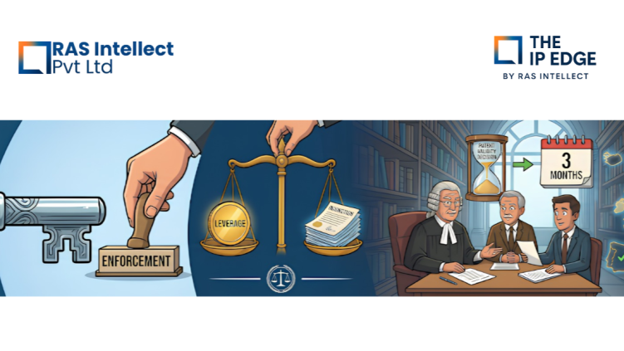
On November 10, 2026, the Unified Patent Court’s Local Division in The Hague ruled that the COVID-19 vaccine Comirnaty, made by Pfizer and BioNTech SE , infringes a patent owned by GSK. The court granted an injunction covering much of Europe. But it also ruled that the injunction cannot be enforced yet, and may never need to be, if the companies agree a licence.
That unusual structure is the real story. It shows how a court can use a patent ruling to push parties towards a commercial deal, and it is a useful case for anyone who wants to understand how patents actually create value.
The patent, the court, and the ruling
The patent is EP 2 590 626, which protects liposomes used to deliver RNA in vaccines. The Unified Patent Court, or UPC, is a single patent court shared by 18 EU member states that began operating in 2023. Its Hague Local Division, with Edger Brinkman presiding, decided the case.
According to ip fray’s report, the court upheld 12 claims of the patent and found that Comirnaty infringes six of them. It revoked one medical-use claim for insufficiency. JUVE Patent reports that the patent survived all five of the defendants’ invalidity attacks, apart from that one claim. Insufficiency, meaning that a patent does not describe the invention clearly enough to let others carry it out, is also a ground for revocation under Indian law, in Section 64(1)(h) of the Patents Act, 1970, so it will be familiar to anyone preparing for the Indian Patent Agent Examination.
An unusually wide territory
The injunction covers all European Patent Convention countries where the patent is valid, except Ireland and the UK. That includes the 18 UPC member states, seven further EU states, Iceland, Norway and Switzerland, and several non-EU states such as Turkey.
The court reached that scope by applying what JUVE calls the UPC’s developing “long-arm jurisdiction.” It found that the Pfizer and BioNTech groups operate as an interdependent, centrally controlled structure, and treated several entities within them as anchor defendants. For countries outside the UPC system, the injunction carries an extra condition: it applies only if the national courts do not hold the patent invalid.
The twist: an injunction with conditions
The court did not make the injunction immediately enforceable. It postponed enforcement until the UPC gives a final decision on the patent’s validity. Even then, the injunction takes effect only if Pfizer and BioNTech have not signed a licence with GSK within three months of that decision.
JUVE reports that the panel acknowledged GSK’s position as a “non-implementer” seeking monetary compensation rather than market exclusivity, and that this framing effectively channels the dispute towards a commercial resolution. In plain terms, the court treated GSK as a company that wants to be paid, not one that wants a competing product off the market. Market coverage of the ruling reached a similar conclusion, describing it as strengthening GSK’s position in licensing talks.
The ruling also carries immediate consequences of a different kind. The companies must provide detailed sales information going back to January 2020 and pay interim damages of €2 million. The court set the value of the case at €50 million.
What happens next
This is a first-instance ruling, and it is not the end of the dispute. Pfizer and BioNTech can appeal, and they have already filed a revocation action at the UK High Court and begun parallel proceedings in Ireland. Two further GSK patents are pending before the same division, with hearings postponed while European Patent Office revocation proceedings run. The coverage reviewed for this piece does not include a response from either company.
GSK’s dispute with another vaccine maker took a different route. In the parallel case against Moderna, the court did not issue a decision, because the parties asked to withdraw the claims. According to Reuters, as reported by JUVE, GSK and Moderna settled on October 28, 2026. They agreed to cross-license each other’s patents in infectious diseases, with no payments exchanged.
Why this matters
Three points stand out for people who work with patents, or build businesses that depend on them.
First, a patent win is often about leverage. Here, both the ruling and the settlement point to licences as the likely end of the story, rather than a product being taken off the market.
Second, courts have more remedies available than a simple yes or no. An injunction that exists on paper but is conditioned on validity and licensing talks is a different tool from one that bites immediately.
Third, cross-border patent enforcement is evolving quickly. JUVE notes that a Dutch district court took a similar conditional approach to a cross-border injunction a month earlier in a dispute between Halozyme and MSD.
For an Indian reader, there is a loose parallel in our recent bulletin, where the Delhi High Court ordered Xiaomi to deposit ₹272 crore as security in a standard essential patent case. The tools and the legal settings differ, and the situations are not the same. But in both, the court is managing the pressure on the parties while a licensing dispute plays out. That, more than the headline about an injunction, is what to watch.
Sources consulted for this piece: JUVE Patent, “Partial victory for GSK against BioNTech and Pfizer in UPC dispute” (November 12, 2026); ip fray (November 10, 2026); and market coverage of the ruling by ad-hoc-news, for the interim damages and the licensing window. The Moderna settlement details are as reported by Reuters via JUVE Patent. This piece was independently researched and written; no text has been reproduced from any source beyond the short quoted terms above. The decision itself was not read in full, it is a first-instance ruling, and the position may change.