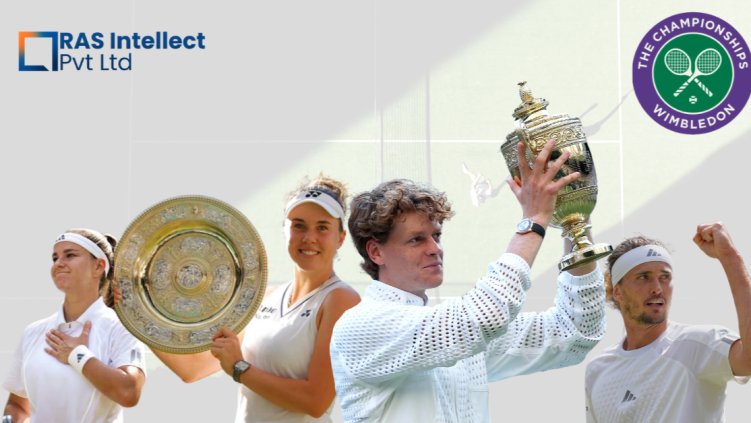
The 2026 Championships ran from June 29 to July 12 at the The All England Lawn Tennis & Croquet Club Limited (AELTC), with a record £64.2 million prize fund, the biggest single-year increase in the tournament’s 149-year history. Behind the all-white dress code, the grass courts, and the strawberries and cream sits one of the most actively managed intellectual property portfolios in world sport. A quick look at what is actually protected, licensed, and enforced.
Trademarks: the name, the logo, even the colours
The AELTC has filed at least 13 EU trademark applications since 1996, alongside a long list of UK registrations covering Wimbledon , The Championships, Wimbledon , ALL ENGLAND CLUB, ROAD TO WIMBLEDON, and even BREAKFAST AT WIMBLEDON. The tournament’s purple and green colour scheme and the crossed rackets emblem function as brand identifiers in their own right, alongside the trophy designs. This portfolio is what allows AELTC to run a merchandising business, license co-branded products (Polo Ralph Lauren® ‘s Wimbledon sunglasses line is a current example), and take action against counterfeit goods sold around the grounds.
Patents: the technology calling the lines
Wimbledon retired human line judges in 2025 after 148 years, moving fully to Hawk-Eye Innovations‘s Live Electronic Line Calling system, 18 cameras per court producing a real-time 3D read on where the ball lands. For 2026, AELTC added video review on six show courts, letting players ask the umpire to re-check judgement calls like double bounces or net touches. Hawk-Eye itself is patented ball-tracking technology, licensed into the tournament rather than built by it, a reminder that even the “objective” call on a line is running on someone else’s IP.
Copyright: the broadcast is a separate asset from the sport itself
Nobody owns the game of tennis. But the broadcast of a match is a copyrighted work in its own right, which is why rights deals are negotiated court by court, territory by territory. The BBC’s relationship with Wimbledon goes back to radio coverage in 1927, and was extended in 2026 on similar financial terms through 2033. In the US, ESPN holds rights through 2035 in a deal reportedly worth around $95 million a year. Secondary UK rights for the finals sit with TNT Sports U.S. , and the tournament is broadcast in more than 220 territories through separate regional deals (beIN Sports in France, Prime Video & Amazon MGM Studios in Germany, Movistar Plus in Spain, Sky in Italy). Each of those is a distinct copyright license, not a single global grant.
Sponsorship and the ambush marketing rulebook
The 2025 edition ran 17 official sponsorships worth a combined $124 million a year, led by Barclays as banking partner and Emirates as airline partner. What protects that revenue isn’t just the sponsorship contracts themselves, it’s AELTC’s published ambush marketing policy, designed to stop non-sponsors from creating an unauthorised association with the tournament through advertising, promotions, or unofficial merchandise near the grounds. This is standard practice at major global events, and it relies directly on the trademark and passing-off protections described above.
Player-level IP on the same courts
Some of the brand history on court predates the tournament’s own trademark filings. Fred Perry , the brand, was founded by a three-time Wimbledon champion. René Lacoste , “the Crocodile,” built one of the first athlete-founded fashion labels off the back of his own playing career. More recently, players like Roger Federer , Andy Murray , and Serena Williams have run personal product lines with their own registered trademarks, layering individual IP on top of the tournament’s.
Why this is worth sitting with
None of this diminishes the sport. If anything, it is a useful case study in how a 149-year-old institution keeps a “timeless” experience commercially viable: not through one blockbuster IP right, but through trademarks, patents, copyright, and enforcement policy all working in parallel, each doing a different job. For anyone studying IP law, Wimbledon is arguably a cleaner teaching example than most tech disputes, because every layer of protection is visible if you know where to look.
Facts and figures above are drawn from AELTC’s own trademark registration filings, and reporting by Mondaq , SportsPro , IBC Netherlands , Ed White Law, and BusinessWire , current as of July 2026.