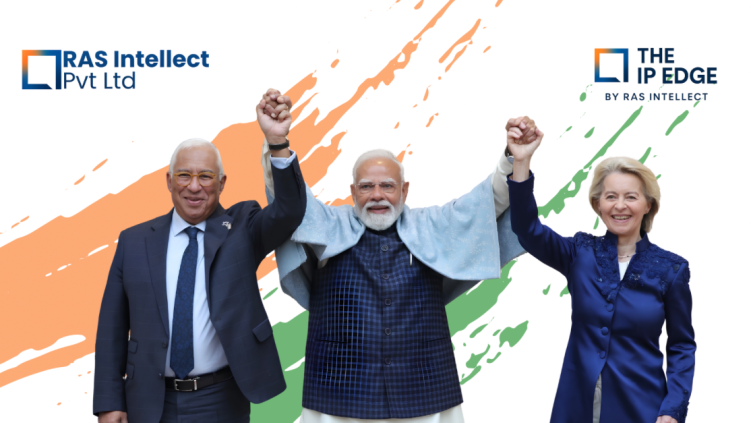
India and the EU just struck the "mother of all trade deals." Its IP chapter took nearly two decades to write.

India and the EU just struck the “mother of all trade deals.” Its IP chapter took nearly two decades to write.

On January 27, 2026, India and the European Union announced the conclusion of negotiations on a free trade agreement connecting the world’s fourth-largest economy with a bloc European Commission President Ursula von der Leyen said would create “a free market of two billion people, accounting for a quarter of global GDP.” Talks had opened in 2007, stalled in 2013, and resumed only in 2022. Nearly nineteen years after they began, one of the quieter but most consequential parts of the deal is its standalone intellectual property chapter, covering copyright, trademarks, industrial designs, trade secrets, and plant variety protection.

The agreement has not yet entered into force. It still requires legal review, formal signature, European Parliament approval, and ratification on both sides. As of this week, that process is moving: Commerce and Industry Minister Piyush Goyal said on July 15 that the legal review of the FTA text is nearly complete, and confirmed in Helsinki on July 16 that both sides have agreed to formally sign the agreement before the end of 2026, with it coming into force in the first quarter of 2027, shortly after the India-UK FTA, which became operational on July 15. Modi, von der Leyen, and European Council President António Costa also reaffirmed the commitment to an early signing at the G7 summit in Évian on July 17.

But the terms already agreed reveal a great deal about how two very different IP philosophies were reconciled, and what each side had to give up to get there.

The fight that nearly sank two decades of talks

For most of this negotiation’s history, the single biggest obstacle was a demand that had nothing to do with trademarks or copyright at all: data exclusivity for pharmaceuticals. The EU wanted India to grant a period during which originator drug companies’ clinical trial data could not be relied upon by generic manufacturers seeking approval for a copy of the same drug, effectively delaying generic entry regardless of patent status.

India’s generic pharmaceutical industry, valued at roughly $25 billion and responsible for supplying more than 80 percent of the medicines Médecins Sans Frontières uses to treat HIV patients globally, opposed this for years, as did international health groups. India’s Commerce Secretary has separately stated, in the context of related trade talks, that data exclusivity would not be accepted in any FTA out of concern for the domestic generic industry. In the final India-EU agreement, data exclusivity and blanket patent term extensions were not included in the form the EU had originally sought, a significant outcome for a chapter that took eighteen years to close.

Geographical indications, and an old argument about basmati

The IP chapter also addresses geographical indications, the legal mechanism that lets products like Champagne, Parma ham, and Darjeeling tea claim exclusive rights to their name based on origin. This has historically been one of the more sensitive parts of India-EU trade talks. Basmati rice is the clearest example of how sensitive: India filed for EU protected geographical indication status for basmati in 2018, and the European Commission published the application for opposition in 2020. Pakistan, which grows basmati in the same traditional belt straddling the two countries’ Punjab regions, formally opposed the claim, arguing the rice is a shared regional product rather than an exclusively Indian one. As of the most recent reporting, the EU has not granted exclusive basmati GI status to either country, and the dispute remains unresolved even as the wider FTA has been concluded. Darjeeling tea, by contrast, secured EU GI protection back in 2011 without a competing national claim to work around. The new FTA is expected to expand mutual recognition of GIs between the two markets going forward, though it does not appear to resolve the basmati question on its own.

A quieter provision, with roots in a much older dispute

One detail worth noting: the chapter explicitly recognises India’s Traditional Knowledge Digital Library, a searchable database the Indian government built specifically to stop foreign patent offices from granting patents on traditional Indian knowledge that isn’t actually new. The concern is not hypothetical. India spent years and real legal resources overturning patents granted elsewhere on the wound-healing properties of turmeric and the pesticidal use of neem, both well-documented traditional knowledge that patent examiners abroad had no way of checking against at the time. Formal recognition of the TKDL in a bilateral trade agreement gives that defensive tool more institutional weight.

What both sides actually got

None of this reads as one side winning outright. India protected its generic pharmaceutical export industry and, by extension, a global public health interest that neither government was eager to be seen undermining. The EU secured a standalone IP chapter with enforcement provisions covering trademarks, industrial designs, and trade secrets, an outcome its own businesses had been requesting through nearly two decades of stalled talks, plus a framework for expanding GI recognition that protects European products in a market of over a billion consumers.

Why this is worth watching closely

Trade agreements rarely make for exciting headlines, and IP chapters within them make for even fewer. But this is a useful case study in how intellectual property functions as a genuine bargaining chip between two economies with different priorities, one exporting affordable medicines to the developing world, the other exporting luxury goods and pharmaceutical innovation. The chapter that took the longest to agree on was not about tariffs or market access in the conventional sense. It was about who gets to control information, and for how long. That question isn’t going away once this deal is signed. It will resurface in every trade negotiation India enters next.


Sources consulted for this piece:

  • European Commission, “The EU-India trade agreement” (official summary), and the EU IP Helpdesk’s January 29, 2026 notice on the agreement’s conclusion
  • Wikipedia, “India-European Union Free Trade Agreement” (negotiation timeline)
  • Organiser and SiliconIndia reporting on Piyush Goyal’s July 15-16, 2026 remarks on the FTA’s legal scrubbing and signing timeline
  • StratNewsGlobal reporting on the July 17, 2026 G7 summit reaffirmation in Évian
  • Lexology / K&L Gates and Lexology / DLA Piper analyses of the EU-India FTA’s IP chapter (February 2026)
  • Mondaq / C&C IP, “The EU-India FTA 2026: Navigating A New Horizon for Trademarks and Brand Enforcement in India”
  • The Tribune, “India rejects European FTA bloc’s ‘data exclusivity’ demand” (on India’s negotiating position regarding generic pharmaceuticals)
  • MSF Access Campaign and org briefings on data exclusivity in India-EU trade talks
  • Kluwer Trademark Blog, “Geographical Indications: India’s PGI application for ‘Basmati'”
  • Policy Circle, “Basmati rice dispute clouds India-EU free trade talks”
  • OnlyFact.in fact-check on the current, unresolved status of the EU’s basmati PGI decision
  • Gulf News and Yahoo News reporting on the India-Pakistan basmati PGI dispute before the European Commission

This piece was independently researched and written for RAS Intellect; no text has been reproduced from any source, and all facts above were cross-checked across multiple independent outlets where possible. Given that the FTA has not yet entered into force, some details, particularly around final ratification and the basmati GI dispute, may change.
Scroll to Top
Sachin Kumar

Sachin Kumar

Publication Trainee

Sachin Kumar is a Publication Trainee at RAS Intellect Solution Pvt. Ltd. Mohali. His core work is in the field of scientific publishing, research communication, and data-driven analytics. He is involved in the publication process of journal articles, conference papers and technical reports, maintaining high standards of quality and academic compliance. With a strong foundation in Business Analytics and Finance, his expertise lies at the intersection of statistics, economics, and psychology. He possesses advanced knowledge of statistical modeling, data visualization, and predictive analytics, with proficiency in Python, R, SQL, and Machine Learning. His deep understanding of statistics, combined with interests in economics and psychology, provides a unique interdisciplinary perspective on consumer behavior, market dynamics, and human decision-making.  He holds an MBA with a major in Business Analytics and a minor in Marketing from Indsearch Institute of Management Studies & Research, Pune, and a Bachelor’s in Commerce (Honours) with specialization in Finance & Accounting from Munger University, Bihar
Untitled design (3) (1)

Aman Kumar Puri

Senior Associate – Business Development

As a Senior Business Development Associate at RAS Intellect Solutions Pvt. Ltd., He is responsible for developing international business opportunities and building strategic relationships with patent attorneys, intellectual property law firms, corporate IP teams, technology companies. His role involves understanding client requirements, identifying opportunities where specialized IP support can add value, and connecting clients with our technical and intellectual property experts to deliver efficient, high-quality solutions.

His primary focus is on creating sustainable international partnerships that enable IP firms and corporate legal teams to access specialized technical expertise, scalable execution capacity, and cost-effective IP support when they need additional bandwidth or specialized capabilities. Through a combination of strategic prospecting, relationship management, consultative selling, and collaboration with technical teams, He works to create opportunities that deliver measurable value to both clients and RAS Intellect Solutions.
Untitled design (3) (1)

Karandeep Singh

IP Manager

Experienced Intellectual Property & Technology Consultant with 9+ years of experience and a demonstrated history of working in IPR Industry. Strong operations professional with a Bachelor of Engineering focused in Electronics & Communication (ECE). Well versed in handling a team of research analysts and work with them to achieve common goals.   Proficient in projects including but not limited to: · Patentability Searches, Invalidation/ Opposition/ Prior Art Searches, FTO, Landscape/White Space analysis, Portfolio Analysis, Design Searches. · State-of-the-art searches, Patent Watch, Infringement analysis · Patent Valuation/ Monetization – Qualitative/ Quantitative Methods, Net Present Value (NPV), Income Based, Market Based Approach. Handled various projects on technologies: · Quantum Computing, Random Number Generators (RNGs), Autonomous vehicle (AV) technology, EMI filters, AI, ML, AR/VR etc. · Limited projects on – 3GPP, ETSI, DVB standards. Worked on presales presentations, discussions, and client calls. Preparation of discussion initiation documents for new client engagements/ meetings and pitching. Database Expertise : Questel Orbit, Patseer, Derwent Innovation, AI based (IPRally, Ambercite, PQAI) etc.

Kriti Pandey

Senior Executive, HR & Accounts

Kriti Pandey is a Senior Executive in HR and Accounts at RAS Intellect, managing end-to-end HR operations alongside financial and compliance processes. With over three years of experience, she oversees employee lifecycle management, payroll, HRIS administration, anorganizational compliance. She has worked with global teams, including supporting a UK-based workforce, and brings strong expertise in compensation, performance management, and employee engagement. An MBA in Human Resources, Kriti focuses on building structured, scalable systems that support efficient business operations. 

Kartik Chauhan

Trademark & Copyright Analyst

Kartik Chauhan is a Trademark and Copyright Analyst at RAS Intellect, working across trademark searches, application support, and intellectual property documentation. He assists in preparing filings, addressing objections, and supporting clients in securing and managing their IP rights. In addition to trademarks, he contributes to patent drafting and corporate compliance processes. With a background in computer science engineering and interests in technology law and research, he brings a multidisciplinary perspective to his work. His analytical and technical skills support both IP protection and compliance-driven initiatives.

Isha Kansal

Senior Patent Analyst

Isha Kansal is a Senior Patent Analyst at RAS Intellect, specializing in patent drafting, filing, and post-filing prosecution support. Her work involves preparing patent specifications, managing paralegal documentation, and handling renewal, restoration, and NBA-related filings. With a strong academic foundation in chemistry and hands-on exposure to organic chemistry and cosmetic science, she brings domain-specific insight to her IP work. Her expertise spans chemical, pharmaceutical, and allied science innovations, where she applies a structured and detail-oriented approach. Isha plays a key role in ensuring accuracy and consistency across critical stages of the patent lifecycle.

Dr. Neha Dhiman

Publication Lead

Dr. Neha Dhiman leads the Publications vertical at RAS Intellect, overseeing end-to-end research publication processes for journals, conferences, and technical reports. With over 12 years of experience in teaching and research, she specializes in scientific writing, academic compliance, and high-quality research communication. Her expertise spans material science, wastewater treatment, and environmental remediation using nanotechnology and agricultural waste. A Ph.D. holder and DST INSPIRE Fellow, she has authored multiple research papers and book chapters and actively contributes as a reviewer and editorial board member. Her work ensures rigorous, publication-ready outputs aligned with global academic standards. 

Shreya Singla

Director HR & Marketing  

Shreya Singla leads Human Resources and Marketing at RAS Intellect, focusing on talent development, brand building, and strategic growth initiatives. A Biology graduate from the University of British Columbia, she brings a research-driven and analytical approach to organizational development and market positioning. 

At RAS Intellect, she is actively involved in hiring, team structuring, and strengthening internal processes, while also driving digital marketing, content strategy, and outreach initiatives. Her work has contributed to significant growth in the firm’s online presence, including increased website traffic, high-engagement campaigns, and expanding visibility across domestic and international audiences. 

She plays a key role in scaling flagship initiatives such as RASPREP, managing student engagement, program execution, and outreach. With a blend of analytical thinking and creative execution, she focuses on building scalable systems, strengthening brand identity, and aligning talent with long-term organizational goals. 

Atul Singla

Co-founder & Director 

Atul Singla is a Co-founder of RAS Intellect and a seasoned industry leader with extensive experience in manufacturing, operations, and business development. As Managing Director of Cable House, Chandigarh, he has led the growth of a well-established enterprise in electrical cables, wiring systems, and allied infrastructure solutions. His expertise spans strategic planning, supply chain management, vendor coordination, and operational scalability across industrial environments. 


With a strong focus on quality compliance and execution efficiency, he brings a practical, business-oriented perspective to organizational growth. At RAS Intellect, he contributes to strategic direction, operational structuring, and long-term business expansion. His approach is rooted in building sustainable systems, ensuring reliability, and driving consistent value across operations. 

Dr. Ruchi Singla 

Director & CEO 

Dr. Ruchi Singla is the Director and CEO of RAS Intellect, bringing over two decades of experience across research, innovation, and academic leadership. She serves as a Scientific Advisor to IP India and has previously held leadership roles including Director at ACIC RISE (NITI Aayog) and Associate Director at Chandigarh University. An accomplished innovation leader, she has guided over 2,300 patent filings and led the establishment of multiple Centres of Excellence, with a focus on emerging domains such as AI, drones, and cybersecurity. 


Recognised among the top mentors in India, she is a Regional Mentor of Change under the Atal Innovation Mission and has actively supported startups, particularly in the agritech space. Dr. Singla holds a Ph.D. in Wireless Communication and is a certified Canadian Patent Administrator from the Intellectual Property Institute of Canada. With extensive contributions to research, patents, and innovation ecosystems, her work is centered on building scalable, impact-driven intellectual property and research frameworks. 

Vanshika Sharma

Business Development Analyst

Vanshika Sharma is a Business Development Analyst at RAS Intellect, with experience in lead generation, client outreach, and academic program management. She is responsible for identifying prospective clients, managing CRM systems, and coordinating outreach for IP services, publication support, and the RASPREP program. She also plays a key role in managing RASPREP operations, including student coordination, communication, and lead tracking. In addition, she supports patent-related work through prior art searches. With a background in computer science and ongoing MBA in Marketing and AI in Business, she brings a structured and data-driven approach to business development. 

Anu Bala coloured

Anu Bala

Intellectual Property Team Lead

Anu Bala is a seasoned intellectual property professional with over 16 years of experience across patents, trademarks, copyrights, and technology transfer. As IP Lead at RAS Intellect, she leads patent drafting and filing strategies, prior art searches, and end-to-end IP prosecution, while also advising on commercialization-focused IP pathways. A Registered Indian Patent Agent and empaneled facilitator under the Startup India SIPP Scheme, she brings strong regulatory and strategic expertise to complex IP matters. She has previously contributed to national-level policy initiatives at ICMR, including the ICMR–DHR Policy on Biomedical Innovation and Entrepreneurship, and has been actively involved in capacity-building and translational research programs. Recognized among the DST Women Scientists under the WISE–KIRAN programme, Anu’s work is centered on transforming research into well-protected, market-ready intellectual property.

Suryavanshi Katoch

Patent Drafter

Suryavanshi Katocis a Patent Drafter at RAS Intellect, specializing in patent drafting, techno-legal analysis, and IP documentation. He has experience working on Indian, U.S., and European patent applications, including claim drafting, FER responses, and invention disclosure development. His technical background in electronics and communication engineering enables him to work across domains such as electronics, mechanical systems, and robotics. He also supports design filings through 3D design preparation and documentation. With a strong focus on clarity and structure, he contributes to developing precise, protection-oriented patent specifications.