On January 27, 2026, India and the European Union announced the conclusion of negotiations on a free trade agreement connecting the world’s fourth-largest economy with a bloc European Commission President Ursula von der Leyen said would create “a free market of two billion people, accounting for a quarter of global GDP.” Talks had opened in 2007, stalled in 2013, and resumed only in 2022. Nearly nineteen years after they began, one of the quieter but most consequential parts of the deal is its standalone intellectual property chapter, covering copyright, trademarks, industrial designs, trade secrets, and plant variety protection.
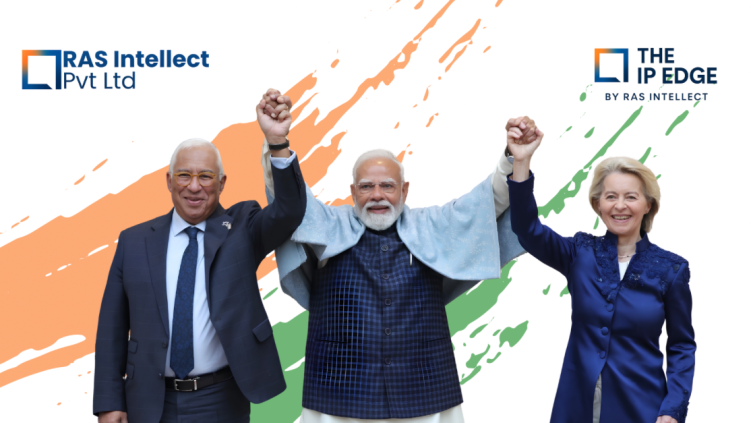
The agreement has not yet entered into force. It still requires legal review, formal signature, European Parliament approval, and ratification on both sides. As of this week, that process is moving: Commerce and Industry Minister Piyush Goyal said on July 15 that the legal review of the FTA text is nearly complete, and confirmed in Helsinki on July 16 that both sides have agreed to formally sign the agreement before the end of 2026, with it coming into force in the first quarter of 2027, shortly after the India-UK FTA, which became operational on July 15. Modi, von der Leyen, and European Council President António Costa also reaffirmed the commitment to an early signing at the G7 summit in Évian on July 17.
But the terms already agreed reveal a great deal about how two very different IP philosophies were reconciled, and what each side had to give up to get there.
The fight that nearly sank two decades of talks
For most of this negotiation’s history, the single biggest obstacle was a demand that had nothing to do with trademarks or copyright at all: data exclusivity for pharmaceuticals. The EU wanted India to grant a period during which originator drug companies’ clinical trial data could not be relied upon by generic manufacturers seeking approval for a copy of the same drug, effectively delaying generic entry regardless of patent status.
India’s generic pharmaceutical industry, valued at roughly $25 billion and responsible for supplying more than 80 percent of the medicines Médecins Sans Frontières uses to treat HIV patients globally, opposed this for years, as did international health groups. India’s Commerce Secretary has separately stated, in the context of related trade talks, that data exclusivity would not be accepted in any FTA out of concern for the domestic generic industry. In the final India-EU agreement, data exclusivity and blanket patent term extensions were not included in the form the EU had originally sought, a significant outcome for a chapter that took eighteen years to close.
Geographical indications, and an old argument about basmati
The IP chapter also addresses geographical indications, the legal mechanism that lets products like Champagne, Parma ham, and Darjeeling tea claim exclusive rights to their name based on origin. This has historically been one of the more sensitive parts of India-EU trade talks. Basmati rice is the clearest example of how sensitive: India filed for EU protected geographical indication status for basmati in 2018, and the European Commission published the application for opposition in 2020. Pakistan, which grows basmati in the same traditional belt straddling the two countries’ Punjab regions, formally opposed the claim, arguing the rice is a shared regional product rather than an exclusively Indian one. As of the most recent reporting, the EU has not granted exclusive basmati GI status to either country, and the dispute remains unresolved even as the wider FTA has been concluded. Darjeeling tea, by contrast, secured EU GI protection back in 2011 without a competing national claim to work around. The new FTA is expected to expand mutual recognition of GIs between the two markets going forward, though it does not appear to resolve the basmati question on its own.
A quieter provision, with roots in a much older dispute
One detail worth noting: the chapter explicitly recognises India’s Traditional Knowledge Digital Library, a searchable database the Indian government built specifically to stop foreign patent offices from granting patents on traditional Indian knowledge that isn’t actually new. The concern is not hypothetical. India spent years and real legal resources overturning patents granted elsewhere on the wound-healing properties of turmeric and the pesticidal use of neem, both well-documented traditional knowledge that patent examiners abroad had no way of checking against at the time. Formal recognition of the TKDL in a bilateral trade agreement gives that defensive tool more institutional weight.
What both sides actually got
None of this reads as one side winning outright. India protected its generic pharmaceutical export industry and, by extension, a global public health interest that neither government was eager to be seen undermining. The EU secured a standalone IP chapter with enforcement provisions covering trademarks, industrial designs, and trade secrets, an outcome its own businesses had been requesting through nearly two decades of stalled talks, plus a framework for expanding GI recognition that protects European products in a market of over a billion consumers.
Why this is worth watching closely
Trade agreements rarely make for exciting headlines, and IP chapters within them make for even fewer. But this is a useful case study in how intellectual property functions as a genuine bargaining chip between two economies with different priorities, one exporting affordable medicines to the developing world, the other exporting luxury goods and pharmaceutical innovation. The chapter that took the longest to agree on was not about tariffs or market access in the conventional sense. It was about who gets to control information, and for how long. That question isn’t going away once this deal is signed. It will resurface in every trade negotiation India enters next.
Sources consulted for this piece:
- European Commission, “The EU-India trade agreement” (official summary), and the EU IP Helpdesk’s January 29, 2026 notice on the agreement’s conclusion
- Wikipedia, “India-European Union Free Trade Agreement” (negotiation timeline)
- Organiser and SiliconIndia reporting on Piyush Goyal’s July 15-16, 2026 remarks on the FTA’s legal scrubbing and signing timeline
- StratNewsGlobal reporting on the July 17, 2026 G7 summit reaffirmation in Évian
- Lexology / K&L Gates and Lexology / DLA Piper analyses of the EU-India FTA’s IP chapter (February 2026)
- Mondaq / C&C IP, “The EU-India FTA 2026: Navigating A New Horizon for Trademarks and Brand Enforcement in India”
- The Tribune, “India rejects European FTA bloc’s ‘data exclusivity’ demand” (on India’s negotiating position regarding generic pharmaceuticals)
- MSF Access Campaign and org briefings on data exclusivity in India-EU trade talks
- Kluwer Trademark Blog, “Geographical Indications: India’s PGI application for ‘Basmati'”
- Policy Circle, “Basmati rice dispute clouds India-EU free trade talks”
- OnlyFact.in fact-check on the current, unresolved status of the EU’s basmati PGI decision
- Gulf News and Yahoo News reporting on the India-Pakistan basmati PGI dispute before the European Commission
This piece was independently researched and written for RAS Intellect; no text has been reproduced from any source, and all facts above were cross-checked across multiple independent outlets where possible. Given that the FTA has not yet entered into force, some details, particularly around final ratification and the basmati GI dispute, may change.